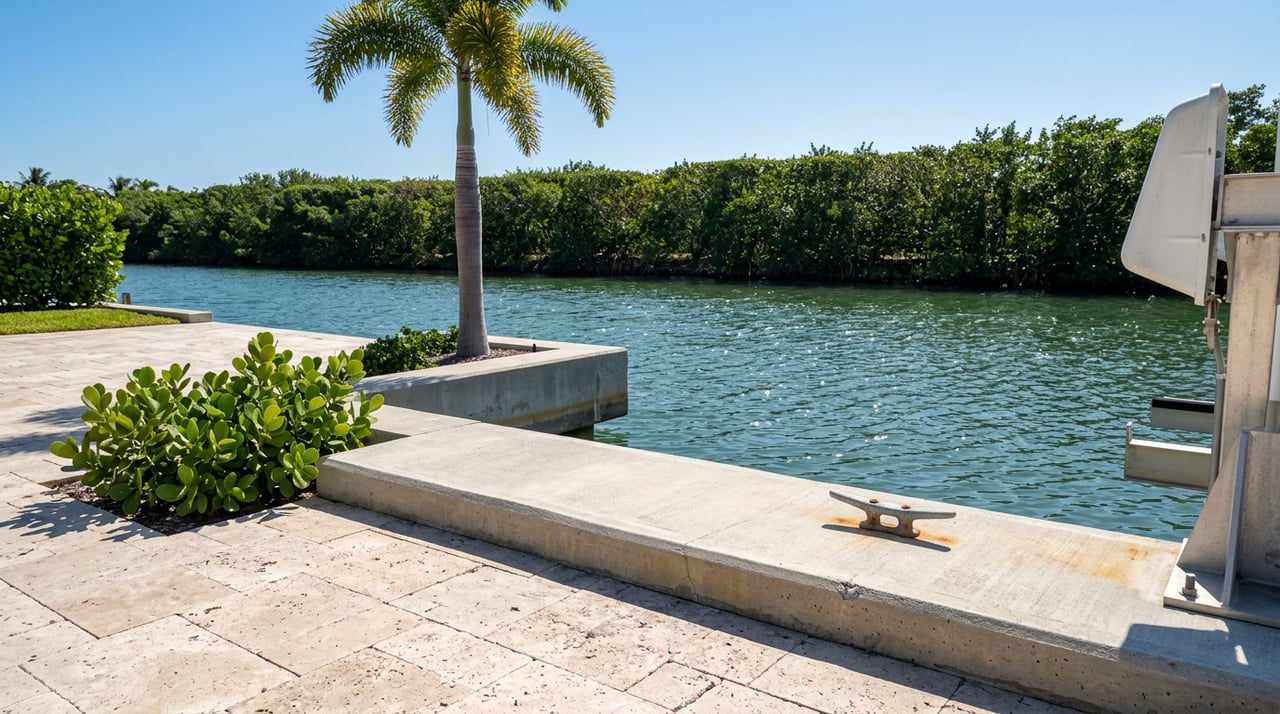
In April 2025, the City of Fort Lauderdale sent a barge into the canal along Bayview Drive, just south of the Bay Colony Drive bridge, and started replacing a seawall. The scope was specific: fifty feet of new sheet pile and a new concrete cap, built by David Mancini & Sons under an emergency contract. Work started April 23 and wrapped by the end of May. Then it stopped.
The city's own notice said the rest of that same seawall, running toward NE 59th Street, would wait for a future project. The phase described in the notice covered fifty feet. The seawall right next to it stayed exactly as it was.
That detail matters more than it looks like it should, because it captures something Bay Colony sellers and buyers routinely get wrong about their own seawalls: a repair is not a fixed, self-contained thing you can price like a roof patch. It's a scope decision, and in Fort Lauderdale, the size of that scope determines whether you're allowed to call it a repair at all.
The Line That Turns a Patch Into a Substantial Repair
Breezy Permits' guide to Broward County permits describes a threshold that catches a lot of waterfront owners off guard: once work on a seawall crosses roughly half its shoreline length, or once the associated cost passes half the value of the flood barrier along that shoreline, the project stops being a repair under the code. It becomes a substantial repair, and, as an EIN Presswire report explains, a substantial repair has to be brought up to current elevation standards along its entire length, not just the section that was actually damaged.
A marine contracting company serving Broward and Palm Beach counties put it plainly in guidance published this year: a seawall repair that touches more than half the wall "legally requires the whole structure raised to current elevation." The Bayview Drive project covered exactly fifty feet. Under the code, crossing the substantial-repair threshold changes the scope, the permitting, and the cost.
For a Bay Colony estate, where marketed listings have advertised as much as 165 feet of protected dockage on a single point lot, this is not an abstract code footnote. It is the difference between a contractor invoice in the tens of thousands and one that runs well into six figures, because crossing that line means new sheet pile, a new cap at a taller elevation, tiebacks, and in many cases riprap habitat protection along the waterward face, which Broward's environmental code now requires on new and substantially repaired flood barriers.
The County Baseline and Local Requirements
Here is the part that trips up sellers who did their own research and stopped one search result too early.
Broward County's coastal resilience policy gives most municipalities a phased runway: seawalls need to reach 4.0 feet NAVD88 by January 1, 2035, and 5.0 feet NAVD88 by 2050. That's the countywide baseline, and it's the number that shows up first in a lot of general search results about Florida seawall rules.
Fort Lauderdale, according to multiple sources tracking the city's own tidal barrier ordinance, isn't running on that same clock.
| Broward County baseline | |
|---|---|
| Interim elevation | 4.0 ft NAVD88 by Jan 1, 2035 |
| Current requirement | Phased |
| Final elevation | 5.0 ft NAVD88 by 2050 |
Sources on the exact city timeline aren't perfectly uniform, which is itself worth knowing. If you're planning seawall work in Bay Colony, the right move isn't to trust any single blog's summary of the code, including this one. It's to call the city's permitting office and get the current elevation requirement in writing for your specific parcel before a contractor gives you a number.
What This Means If You're Selling
If you own a Bay Colony estate and a section of seawall needs attention, the question to ask your contractor isn't "what will this cost." It's "how much linear footage does this scope touch, and does that cross the substantial-repair line."
A few things worth pulling together before you list:
- Full permit history for any dock, seawall, or pile work done on the property, confirmed with both the city and Broward County.
- A written note from your marine contractor on the current top elevation of the wall, measured against NAVD88, and whether prior work already brought any section up to code.
None of this is a home inspector's job. Seawall condition sits with a marine contractor or coastal engineer, and a buyer's team will treat it that way whether you've prepared for it or not.
What This Means If You're Buying
"New seawall" in a listing description is marketing language until you've seen the permit. Ask for the specific elevation the wall was built to, not just the year it was installed.
If the seller's seawall has had partial work done, like the fifty feet on Bayview Drive, ask directly whether that work crossed the substantial-repair threshold or stayed under it. A partial repair that stayed under the line may mean the rest of the wall is still sitting at an older, lower elevation, which becomes your problem the day you need to touch it.
Given how easy it is to leave this until a home inspection, ask what elevation the wall meets. If a seller can't say, treat that as a cost-to-cure conversation before you write an offer, not after.
The Line Runs Through the Neighborhood, Not Around It
The city's own Bayview Drive project is proof that this isn't a hypothetical for Bay Colony. It's a real seawall, on a real street inside the neighborhood, with work planned in phases. A future project will eventually finish the section toward NE 59th Street. Until it does, two adjoining stretches of the same canal are governed by two different standards, on the same block.
That's the reality every Bay Colony waterfront transaction sits on top of: not a single seawall condition, but a patchwork of individual repair histories, each one shaped by how much of the wall was touched and when.
If you're buying or selling a waterfront estate in Bay Colony and want someone who reads the permit history before the listing photos, Hunter Taravella has spent years working through exactly this kind of condo, co-op, and waterfront association detail across Fort Lauderdale's coastal neighborhoods. Let's Connect and walk through what your specific stretch of seawall actually requires.
This article is general information, not legal, tax or financial advice. Consult a qualified professional about your situation.